- A finding is a claim about something that was said, so it needs the quote and the moment in the call.
- Quotes must be checked against the transcript by code, not just generated.
- Numbers in reports should come from code, and the model's self-reported confidence is not a measure.
- Keep every version of every result, with the prompt, rules and model that produced it.
AI can now read every customer call a contact center handles. It can say which calls were complaints, which customers might leave and which agents skipped a required step. The hard part is no longer producing these answers. It is getting people to act on them.
Show an agent a low score and the first question is “which call, and where?” Show a client a monthly quality report and the first question is “how do you know?” Show leadership a spike in cancellations and the first question is “is this real?” If the answer is “the model said so”, the conversation is over.
A finding is a claim. Claims need evidence.
Every useful finding about a call is a claim about something that was said. “The customer was frustrated.” “The agent promised a callback by Friday.” “The product failed after an update.” Each of these can be checked, because each points to a moment in the recording.
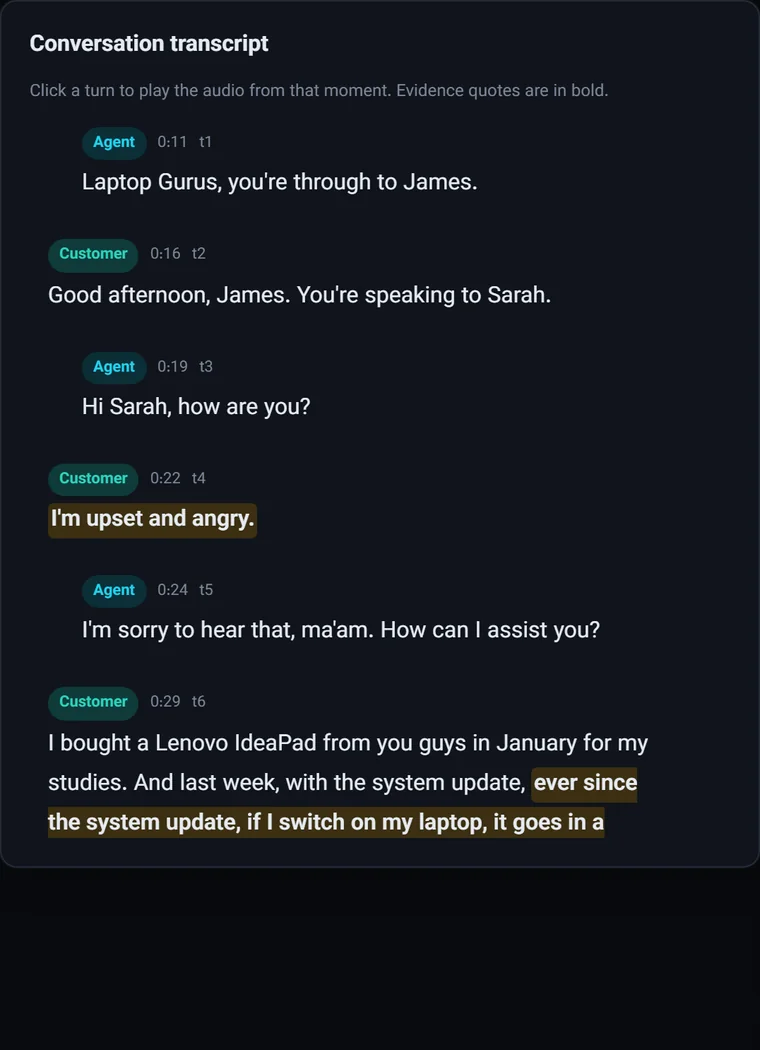
So the standard should be simple: every finding comes with the exact sentence that supports it and the second it was spoken. One click on the finding should land you on that sentence, with the audio ready to play.
If you can't play the moment, you don't have a finding. You have a guess.
What good evidence looks like
Here is a real example from VoiceVera's public case study: a nine-minute call to a computer retailer about a laptop stuck in a restart loop.
| Finding | Evidence | Time |
|---|---|---|
| Customer frustration: yes | “I'm upset and angry.” | 0:22 |
| Possible product defect: yes | “ever since the system update, if I switch on my laptop, it goes in a continuous loop.” | 0:29 |
| Outcome: pending follow-up | The recovery was started, but its result is not known by the end of the call. | — |
Notice three things. Each finding is narrow enough to check. The quotes are the customer's exact words, not a summary. And where the call itself does not settle a question, such as whether the repair worked, the analysis says so instead of guessing.
Compare that with a typical unsupported finding: “Customer sentiment: negative (0.82).” It may well be right, but nobody can tell which part of the call it refers to, and nobody can argue with it productively.
Quotes must be checked, not just generated
Asking a language model to “include a quote” is not enough. Models paraphrase, merge two sentences into one or produce a plausible line that was never said. A quote that looks right but is not in the transcript is worse than no quote, because it borrows credibility it does not have.
The fix is mechanical: after the model answers, code compares every quote with the transcript, word for word, after normalizing punctuation and spacing. Quotes that match are kept as evidence and linked to their turn and timestamp. Quotes that don't are flagged, and the finding is treated as unsupported.
In the showcase of 873 calls, on average 99% of the quotes cited in a call matched the transcript exactly. That number is less interesting than what happened to the other 1%: they were caught by code, not by a customer.
Numbers should come from code
The same rule applies to figures. “Complaints rose 18% this month” is a sentence a model can write fluently whether or not it is true. In a defensible report, the model writes the language and code inserts every number from the data. If a number appears in a report, there is a query behind it, and anyone can click through to the calls it counts.
This also stops a subtle failure: a summary that is right about the direction of a trend but wrong about its size. When the number is computed rather than written, it cannot drift.
The model's confidence is not a measure
Many tools show a confidence score that the model reports about itself. It is tempting to trust it, but a model can be confidently wrong, and self-reported confidence is poorly connected to actual accuracy. Better signals come from the structure of the work:
- Agreement. Do two independent passes over the same call reach the same answer?
- Margin. Is the winning answer clearly ahead of the runner-up, or nearly tied?
- Evidence. Does the cited quote actually appear in the transcript, from the right speaker?
- Audio quality. Was the relevant part of the call transcribed cleanly?
When those checks fail, the call should go to a person, by a fixed rule that anyone can read. That is how a team can explain, months later, why a call was or wasn't reviewed. In VoiceVera, findings also get a grade from A to D that code assigns from these checks, never from the model's opinion of itself.
Keep the history
Prompts improve, categories change and models are upgraded. A defensible system records, for every result, which prompt, schema, rules and model produced it, and it never overwrites an old result with a new one. When a reviewer corrects a finding, the correction is stored next to the original.
When someone asks why last quarter's numbers look different, the answer is in the record, not in someone's memory. And when a dashboard mixes results from different versions, it should say so.
Who needs the evidence
Agents
Agents accept a score they can check. A point lost with a link to the moment is a coaching conversation. A point lost with no explanation is a grievance. Evidence also protects agents: a disputed finding can be settled in seconds by playing the sentence.
QA and team leads
Evidence turns review from re-listening to whole calls into checking specific moments. Reviewers spend their time on the findings that are borderline, not on confirming the obvious.
Clients of outsourcers
For a BPO, a quality report backed by quotes is a different product from a spreadsheet of scores. Clients can spot-check any number themselves. See how this works for BPOs and outsourcers.
Leadership
A trend with ten customer quotes behind it gets acted on. A trend without them gets debated.
A checklist for evaluating call analytics
- Every finding links to a quote and a timestamp, and plays the moment.
- Every quote is checked against the transcript by code.
- Every number in a report is inserted from the data by code.
- Review is triggered by readable rules, not by the model's own confidence.
- Corrections are stored next to the original, never over it.
- Every result carries its versions: prompt, schema, rules and model.
- Every playback of a recording is written to an access log.
None of this makes the AI smarter. It makes it accountable, which is what agents, clients and leaders actually need before they act.
See evidence on your own calls
Free pilot on up to 1,000 of your calls. No contract, no card.