873 customer calls, analyzed end to end
We ran VoiceVera on a public corpus of role-played customer calls: 16 industries, many accents, two channels. This is what it found, and how you can check every finding yourself.
A public corpus, so anyone can check
Customer recordings are private, so for a showcase we used the AppTek Call-Center Dialogues corpus: 873 conversations between an agent and a customer, role-played by 156 speakers across 14 accent groups and 16 industries, from airlines and banking to retail, telecom and delivery.
Each call is recorded on two channels, one per speaker, and runs 5 to 15 minutes. The speakers used fictional names, addresses and account details, so no real customer appears anywhere on this page.
Corpus: Beck et al., AppTek Call-Center Dialogues: A Multi-Accent Long-Form Benchmark for English ASR (2026), licensed under CC BY-SA 4.0. The screens on this site that show its content are adaptations and are shared under the same license.
The same steps as for a customer
- Speakers by channel. Which channel is the agent was detected for each call, because it changes from call to call.
- Transcription of both channels, with timestamps for every turn.
- Analysis of every call: summary, topic, intent, outcome, customer experience, follow-up, risks and opportunities.
- Verification by code. Every quote checked against the transcript; low-margin decisions sent to review.
- Lists and dashboards built from the results, with every figure computed by code.
Why customers called, and how it ended
All 873 calls, counted by code from the analysis of each call.
Reason for the call
Top topics, number of calls
Outcome
Share of all calls
637 calls needed a follow-up from the business, each listed with an owner and due date.
Customer experience
Calls with each signal, a call can have several
On the positive side, 471 calls ended with a satisfied customer and 310 with explicit thanks.
From calls to a to-do list
Calls that need action are sorted into lists, each item with the sentence that put it there.
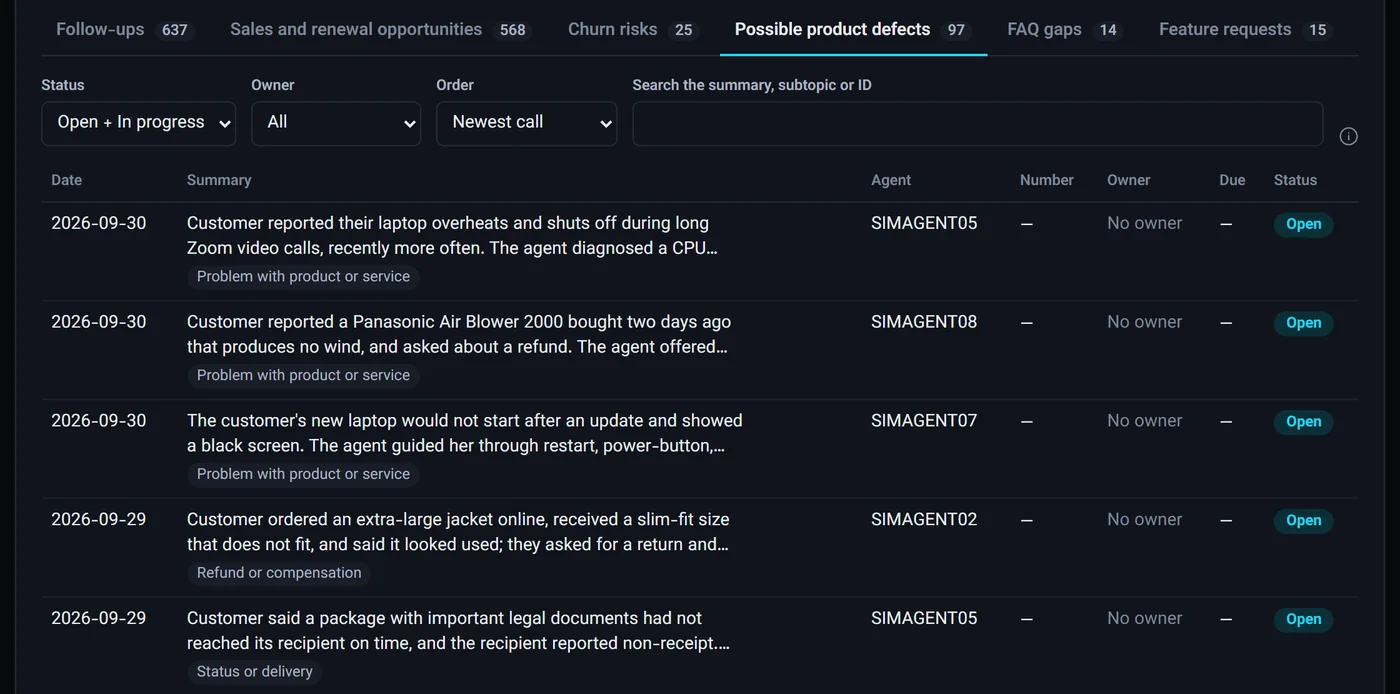
A laptop stuck in a restart loop, and an angry customer
A nine-minute support call to a computer retailer. Here is how VoiceVera read it, and where each conclusion comes from.
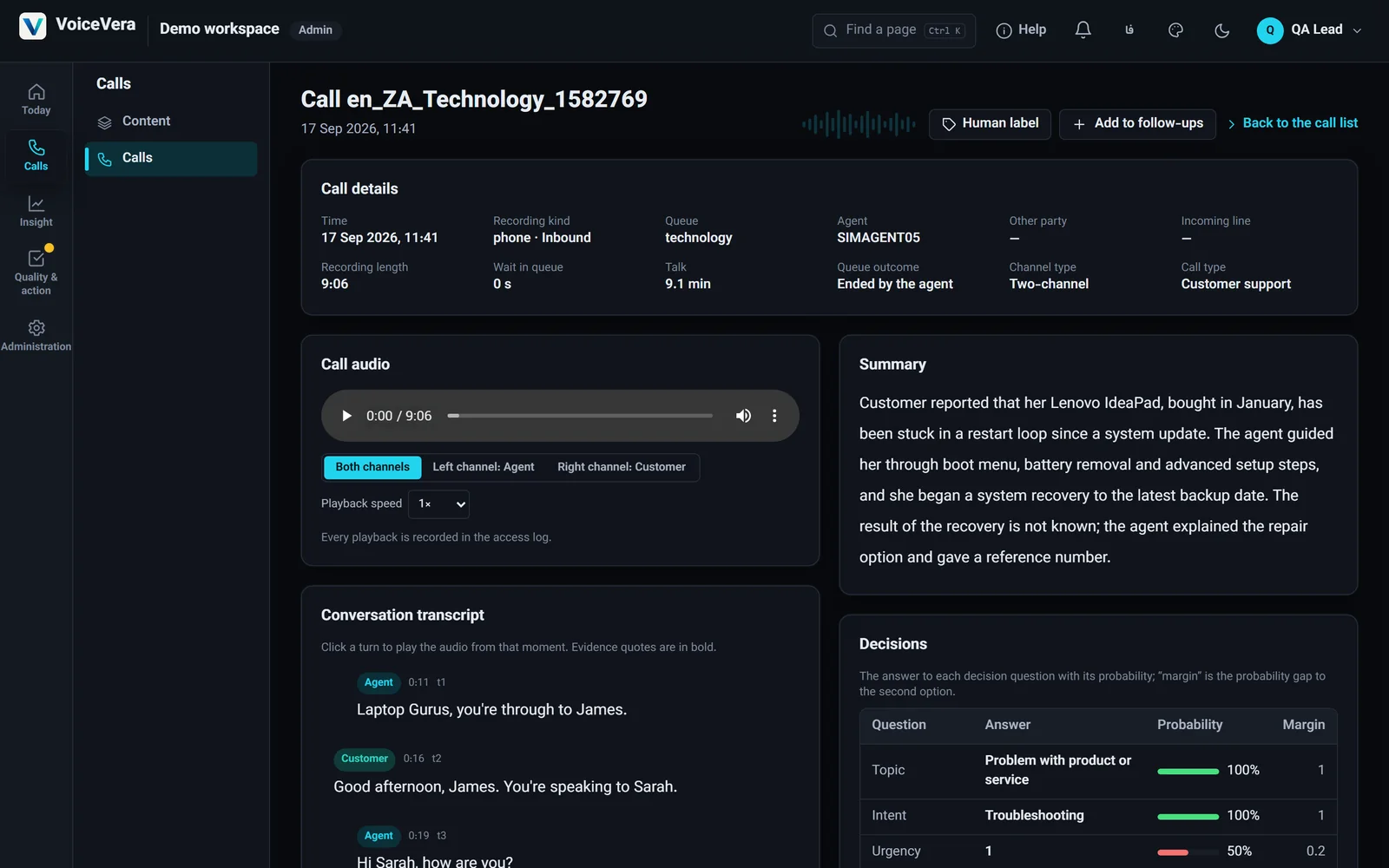
What the analysis says
- Frustration: yes (96%). Evidence at 0:22: “I'm upset and angry.”
- Possible product defect: yes (73%). Evidence at 0:29: “ever since the system update, if I switch on my laptop, it goes in a continuous loop.”
- Outcome: pending follow-up. The recovery was started but its result is not known by the end of the call.
- Churn risk: no (96%), with a margin wide enough that no review was needed for it.
What it was honest about
The recording has a few unclear passages. Instead of guessing, the analysis lists them as ambiguities, marks the transcript problem as minor and notes that the agent's repair price and turnaround are the agent's statements, not confirmed outcomes.
Built to ask, not to guess
For this showcase we used VoiceVera's default review rules, without tuning them to the data. With those rules, many calls were sent to human review, mostly because two independent decisions disagreed or because the winning answer had a small margin. That is by design: when the evidence is thin, VoiceVera asks a person instead of guessing.
In a pilot we tune the review rules on a sample your team labels, so reviewers spend their time where it matters.
Read it for what it is
These are role-played calls, not a customer's production traffic, and the figures describe this corpus only. What carries over is the method: every call analyzed, every finding tied to a sentence, every number computed by code.
The best way to judge VoiceVera is on your own calls. That is what the free pilot is for.
See the same on your calls
Free pilot on up to 1,000 of your calls.