- Support calls are one of the few places customers explain what is wrong before they leave.
- Listen for six signals: intent to leave, competitor mentions, repeat contacts, broken promises, billing surprises and unresolved frustration.
- Turn signals into a daily retention list, each item with the customer's words and an owner.
- Count signals from every call to find the root causes, not just the at-risk customers.
Most churn analysis looks backward. A customer cancels, the account shows up in a monthly report, and someone tries to work out why. By then the reasons are guesses, and the customer is gone.
Support calls are one of the few places where customers explain, in their own words and before they leave, what is going wrong. Some say outright that they are thinking of cancelling. Many more say something that predicts it: the third call about the same problem, a mention of a competitor's price, a promise that was not kept. This article covers what those signals sound like, how to find them in every call and what to do once you have them.
Why calls are an early warning system
Usage data tells you a customer is doing less. Surveys tell you how a small fraction of customers felt on the day they answered. Calls tell you what happened and why, often at the moment the customer is deciding. A customer who calls to complain is still talking to you, which makes them more recoverable than one who leaves silently.
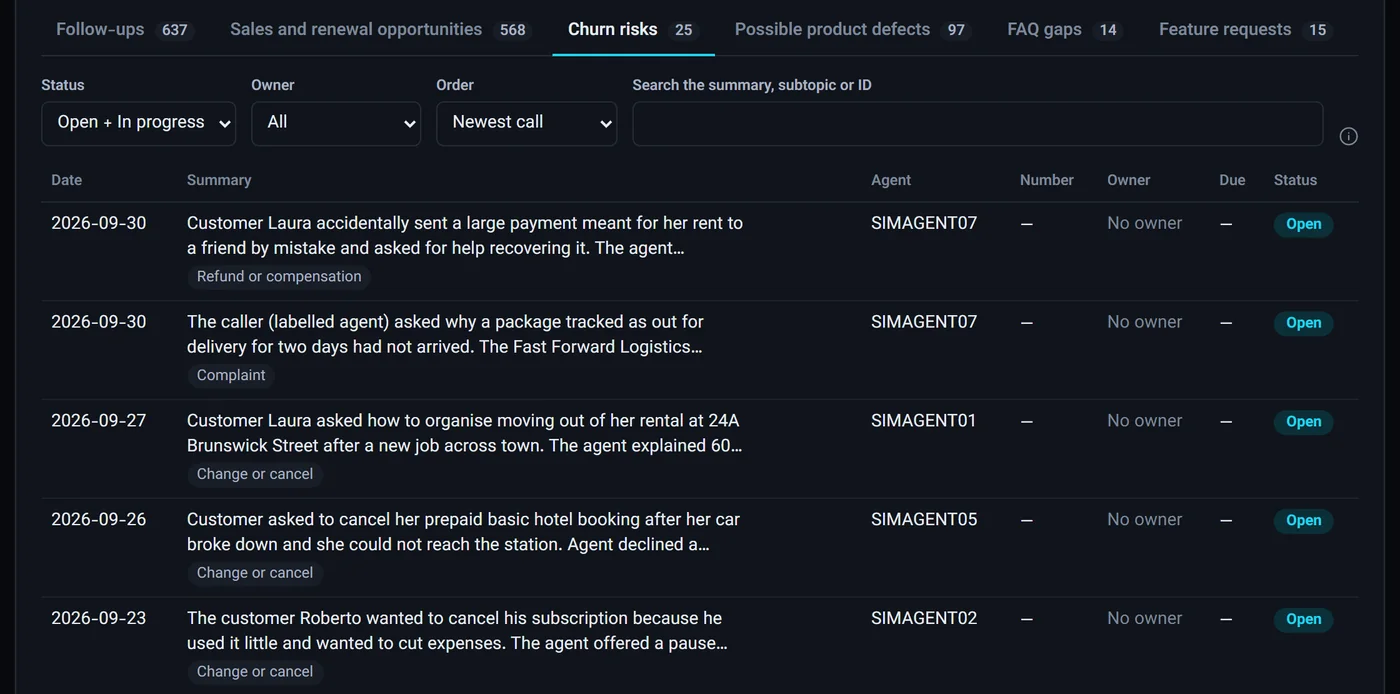
The challenge is volume. The signals are rare relative to all calls, and a small QA sample will miss most of them. In VoiceVera's public showcase, 25 of 873 calls were flagged as churn risks, and only 4 contained an explicit threat to leave. A sample of a few calls per agent would almost certainly contain none.
Six signals to listen for
1. Explicit intent to leave
The clearest signal: “I want to cancel”, “I'm going to close my account”, “this is the last time I'm ordering from you”. It sounds easy to catch, but context matters. A customer calling to cancel one order is not leaving the business. A customer asking how cancellation works “just in case” might be. Good detection reads the whole call, not just the keyword.
2. Competitor mentions
“Your competitor offers this for less”, “I can get the same thing at another store”. A named competitor is a strong signal because it means the customer has already looked. Keep a list of your competitors' names, including common misspellings and nicknames, and use it alongside the analysis.
3. Repeat contacts about the same unresolved issue
One call about a late delivery is ordinary. The third call about the same late delivery is a customer whose patience is running out, even if they are polite. This signal is invisible in any single call; it appears only when calls are linked over time by customer. Linking can be done without exposing phone numbers, using an irreversible identifier per customer.
4. Broken promises
“You said someone would call me back yesterday.” When a customer reports that a previous promise was not kept, trust is already damaged. Track promises made by agents, such as callbacks and resolution dates, and check whether they were met. One rule we follow: if there is no evidence either way, a promise is “unknown”, never “overdue”. Marking a promise as broken should take evidence or a person's decision.
5. Billing surprises and price objections
Unexpected charges, a price increase the customer did not notice, a refund that did not arrive. Money problems escalate quickly and are a common trigger for cancellation, especially on subscriptions.
6. Strong frustration that ends without resolution
Frustration on its own is common and often resolved within the call. Frustration combined with an unresolved or unclear outcome is the pattern to watch. In the showcase, 62 calls showed frustration and 12 showed anger, but the calls that matter most are the subset where the outcome was not a resolution.
How to find churn signals in every call
- Transcribe every call, with timestamps and speakers. A threat to leave counts only if the customer said it, so two-channel recording helps.
- Ask a specific question of each call: is there a sign this customer may stop doing business with us? Require the answer to include the customer's own words.
- Check the quote by code, so every item on the list is backed by a sentence that was actually said.
- Combine with rules for signals a single call can't show: repeat contacts on the same issue and promises past their date.
- Send borderline calls to a person by a readable rule, for example when two independent passes disagree.
From signal to action: the retention list
A churn signal that ends up in a dashboard does nothing. The output should be a list, refreshed daily, where each item has:
- The customer (as an internal identifier) and the call, with a link that plays the moment.
- The signal type and the customer's exact words.
- An owner: a retention specialist, a team lead or the account manager.
- A due date, short enough to matter: same day or next business day.
- A status and a closing note: called back, offered a fix, escalated, no action needed.
Then measure the loop: what share of churn-risk calls received a follow-up, and how fast. That “loop closure” rate is a better management metric than the number of signals, which depends on how many customers called.
Look for the root causes, too
A retention list saves individual customers. The aggregate tells you why customers are at risk in the first place. Once churn signals are counted from every call, you can group them by topic, product, queue or week and ask better questions: are most signals about delivery, billing or a recent change? Did they rise after a policy update? Are they concentrated in one region or channel?
Two habits keep this honest. Compare like with like, for example cancellation calls this month against cancellation calls last month, not against all calls. And check whether a pattern holds within each group, not just overall, since mixing groups can reverse a trend. Then open the calls behind the number. Ten customer quotes about the same problem will persuade a product team faster than any chart.
Getting started
- Write down what churn means for your business: account closure, subscription cancellation, no order in 90 days.
- List your competitors and the words customers use for cancelling.
- Run the analysis on a few hundred recent calls and read every flagged call yourself.
- Decide who owns the list and how fast they respond before you turn it on.
The first list is usually the most valuable, because it contains customers who are at risk right now. For more on why full coverage matters for rare signals like these, see From a small QA sample to every call.
Find the churn risks in your calls
Free pilot on up to 1,000 of your calls. No contract, no card.